

By the time the lights dim at The Listening Room Café, the room already knows what it is. The cocktails catch the amber glow. Plates arrive and disappear with quiet precision. The crowd settles into that increasingly rare posture of anticipation—not rowdy, not distracted, but tuned. Then someone steps onto the stage, leans into the mic, and begins not just to sing, but to tell the story behind the song. In that moment, The Listening Room does what so few venues do anymore: it asks people to listen. In Nashville, that has become its own kind of luxury.
For nearly two decades, Chris Blair has built his legacy on that premise. Not on spectacle, not on noise, not on the easy theater of a city that knows how to sell a good time, but on something more elegant and enduring: reverence for the songwriter. At The Listening Room, the music is not background ambiance to a night out. It is the event. The songwriter is not part of the atmosphere. The songwriter is the center of it. That conviction did not come from theory. It came from experience.
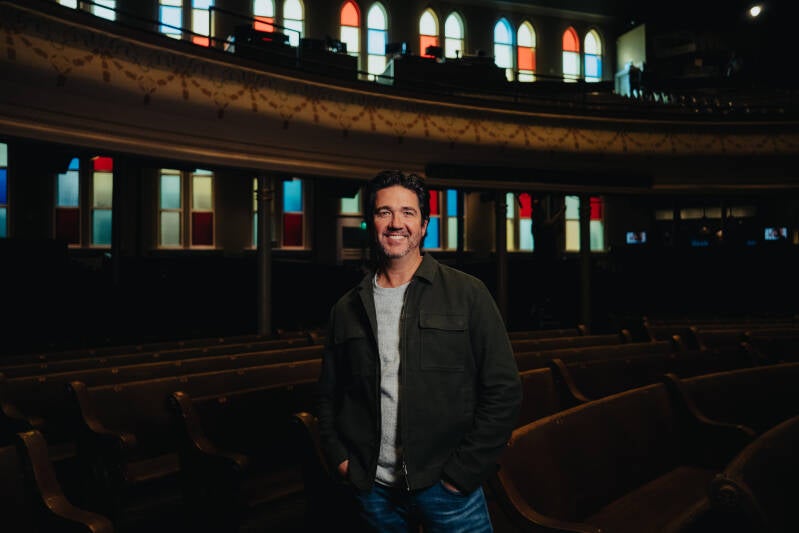
Chris Blair | Photo: Hunter Hart
Blair grew up in Imperial, Missouri, just outside St. Louis, in what he describes as “a little of both worlds—the city wasn’t too far away and the area I grew up in was more of a country vibe suburb.” He spent much of his childhood on his grandparents’ 500-acre farm in Pacific, Missouri, absorbing the work ethic and rootedness that still define him. Music came from everywhere: classic rock from his father, new influences through school, country music later, after changing schools in eighth grade. As a young performer, he traveled with a musical group and sang all kinds of genres, even across Europe. “All of that combined really shaped my love for music,” he says.
When Blair moved to Nashville in 2003, he came chasing the artist’s dream. Like so many before him, he paid his dues on Broadway, playing four-hour cover shifts five nights a week before heading out of town on weekends for his own shows. But somewhere in the grind, his ambitions began to change shape. “I was getting burnt out of the grind,” he says, “but at the same time I was starting to write more songs and felt this burning desire to chase lyrics.” Just as important, he recognized something with unusual clarity: “Songwriters and up-and-coming artists were also not getting a stage to showcase their talents well enough.”
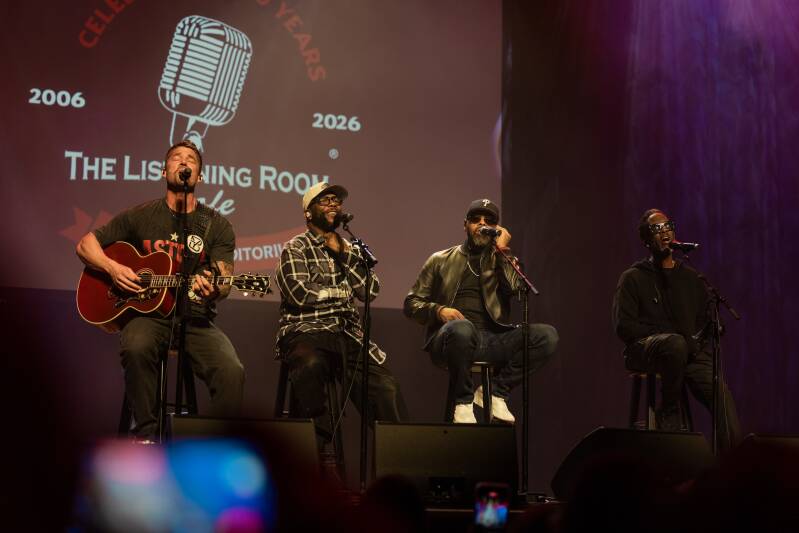
Brett Young and Boyz II Men, Courtesy The Listening Room | Photo: Eric Ahlgrim
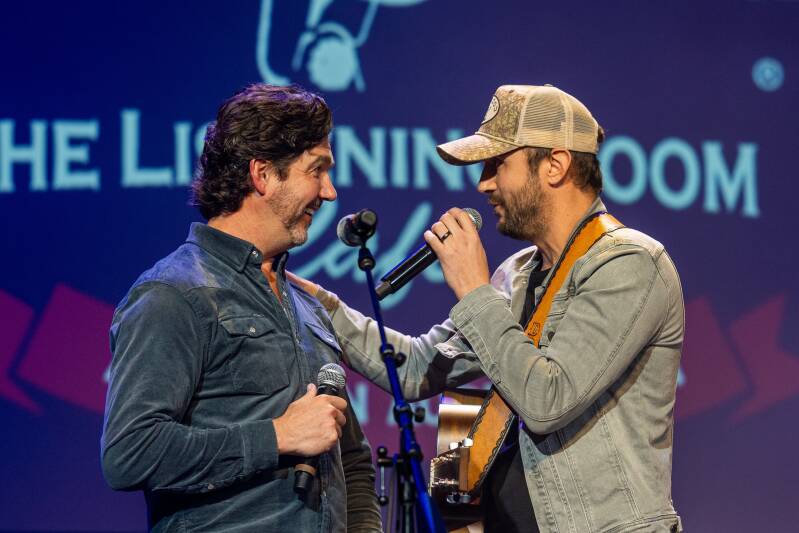
Chris Blair, Drew Baldridge | Photo: Eric Ahlgrim
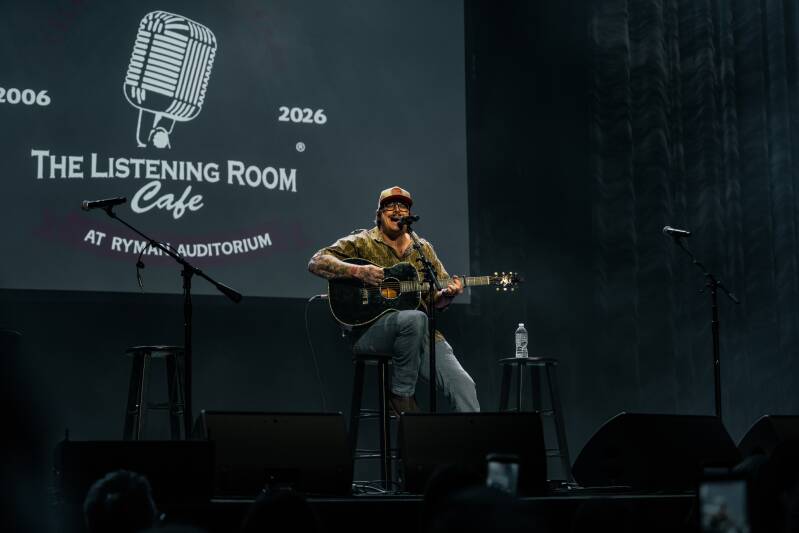
HARDY Courtesy The Listening Room | Photo: Eric Ahlgrim
That realization became the beginning of The Listening Room. The idea arrived in pieces: nights spent sitting onstage during songwriter rounds, counting heads in the audience, doing math in his mind, realizing that venues were profiting while the writers creating the magic were often working for tips, token pay, or nothing at all. “It hit me that it wasn’t fair and that I could do something to fix it,” Blair says. “If someone’s ability is to go into a room and write a #1 hit that becomes the soundtrack of our lives, they don’t get paid very well.” So in 2006, he set out to build something different—a room where the song would never be treated like wallpaper. “I wanted to create a true ‘listening room’ where people could feel comfortable enjoying a meal and some drinks while listening to the stories behind the songs,” he says. “The music is and always will be the center of what we do.”
That last line is the philosophy. Everything else is architecture. Blair’s instinct for hospitality was shaped long before Nashville. His father owned restaurants, and Blair learned young that service is its own art form. “I remember standing on milk crates helping wash dishes at my dad’s restaurant,” he says. He watched, absorbed, learned the rhythm of a dining room and the invisible choreography required to make a place feel effortless. That education would become foundational to The Listening Room, where sound, food, hospitality, and flow are all treated not as separate functions, but as part of the same experience. “It was very important,” Blair says of pairing top-tier sound with thoughtful food and service. “I knew how hard the music business was. And I knew how hard the restaurant business was. To put both of those together adds a larger layer of hardship, but I knew that if I was intentional about creating the right environment with the best sound and food... it should work.” It did—but not easily.
The polished atmosphere that now feels synonymous with The Listening Room was built through years of strain and sacrifice. Blair has been candid about the difficulty of the early days, when passion outpaced profit and survival depended on sheer endurance. “I went through some extremely hard times for years,” he says. “I suffered financially and didn’t take a paycheck for a very long time.” He did every job imaginable himself. “I have been the janitor, the cook, the dishwasher, the bartender, the sound engineer—all of it. I know what it takes.” That all-in devotion still seems to cling to the place. Maybe that is why The Listening Room has managed something so rare: scale without losing soul.

Old Dominion, Courtesy The Listening Room | Photo: Eric Ahlgrim
In 2024 and 2025 alone, the venue sold more than 250,000 tickets to fans from 53 countries and all 50 states. In that same two-year period, it hosted more than 1,500 shows featuring over 2,000 songwriters. Its stage has welcomed icons including Vince Gill, Trisha Yearwood, Chris Stapleton, Carly Pearce, Lainey Wilson, and HARDY, along with the kind of surprise appearances that have become part of its mystique. Blair still sounds astonished by the reach. “Unreal,” he says. “When I think of how this has turned into a global brand that people know, it still just blows my mind.” And yet celebrity has never been the point. What Blair has built is not a star machine, but a sanctuary—one that makes space for both household names and hungry newcomers. “We treat them right, we love them and we support them. That’s it,” he says. “They are just people.” It is this ethos that allows The Listening Room to maintain its intimacy even as its stature has grown. For established artists, it is a return to craft. For aspiring writers, it is validation. For audiences, it is access to the emotional source code of the music they love.

The Listening Room 20th anniversary finale, Courtesy The Listening Room | Photo: Eric Ahlgrim
Ask Blair to name one unforgettable night and he drifts, inevitably, to Garth Brooks—an artist who profoundly shaped his imagination early on. “When he played The Listening Room it was a full circle moment for me,” Blair says, “where I almost had to pinch myself that it was really happening.” Still, he resists choosing only one memory. “They are all unforgettable.”
There is, too, a deeper moral current running through Blair’s work. Through The Listening Room’s Sound Good, Do Good series, the company raised more than $177,000 for worthy causes in 2024 and 2025 alone, part of a philanthropic legacy that has surpassed $1 million overall. Blair traces that commitment to a turning point in 2010, when a benefit concert originally meant to help him and the struggling venue survive became something else entirely. In the wake of Nashville’s devastating flood, he made a split-second decision to give away all of the day’s proceeds. “I made a vow to myself that if we were blessed enough to stay in business that I would give back to a non-profit once a month for as long as we were open,” he says. “I have not missed a month since then.” That sense of service extends beyond the venue. Blair serves on the boards of Operation Song, the MS Society, and the Entrepreneur Organization, and he speaks about leadership less as authority than as example. The more the brand grows, the more it can give. For him, that is part of the point.
Now, as The Listening Room celebrates 20 years, Blair’s vision is expanding again. The sold-out anniversary show at the Ryman was both a milestone and a kind of coronation—a stage filled with artists and songwriters who understood exactly what the room had meant to their beginnings. “It was a very beautiful night of music that I will never forget,” he says. But Blair’s eyes are fixed on the future as much as the past, taking The Listening Room experience beyond Nashville to corporations, cruise lines, festivals, and audiences around the globe.
His mission, however, has never changed. “I hope that we continue to be known as the place that supports and champions songwriters,” he says. “Music is the universal language of the world. Music comes to us through songs. Every song has a songwriter.” That may be the clearest way to understand Chris Blair’s life’s work. He did not just build a venue. He built a philosophy around honoring the people who create what the rest of us carry with us—on the radio, in the car, on dance floors, in heartbreak, in joy, in memory.
In a city obsessed with being seen, Chris Blair made listening the most coveted experience in town. And that, in Nashville, is real power.